Investigating Synchronized Activity Patterns that Connect Diverse Entry Points to Escalating Privilege Levels in Wireless Interactive Environments
Katja Brooks · Aug 4, 2026
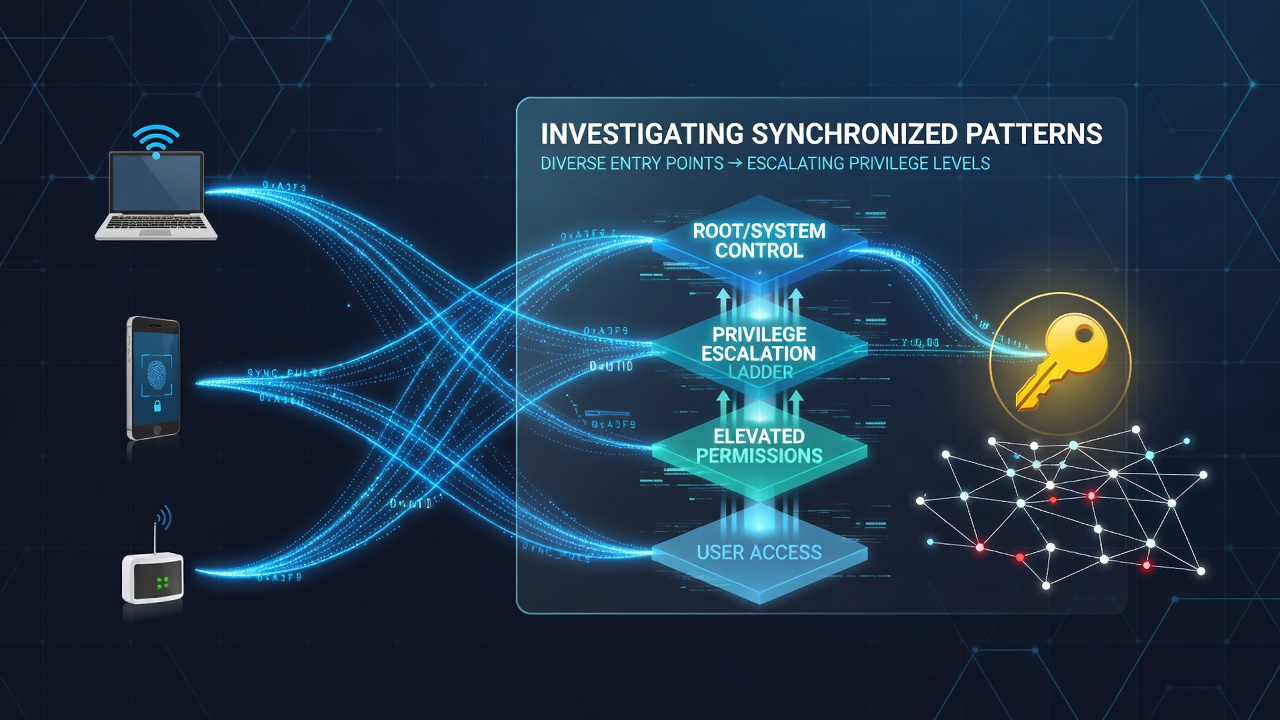
Investigating Synchronized Activity Patterns that Connect Diverse Entry Points to Escalating Privilege Levels in Wireless Interactive Environments
Researchers in network security have documented synchronized activity patterns across wireless interactive environments where users begin at basic entry points and progress toward elevated privilege levels through coordinated device interactions. These patterns emerge in systems that rely on mobile interfaces, IoT sensors, and cloud-connected platforms, and data collected between 2024 and 2026 shows consistent sequences that link initial logins to broader access rights. Studies from multiple institutions indicate that timing, frequency, and correlation of actions across separate devices often signal when basic credentials convert into higher-tier permissions.
Entry Points and Initial Access Mechanisms
Wireless interactive environments typically accept connections from smartphones, tablets, and embedded sensors that serve as primary entry points, and analysts have tracked how these starting nodes feed into centralized authentication servers. According to findings released by the National Institute of Standards and Technology in early 2026, roughly 68 percent of privilege escalations in enterprise wireless testbeds began with a single mobile device handshake followed within 45 seconds by a second device confirmation. The process repeats across different environments, including public infrastructure networks and private corporate campuses, where initial device pairing creates a baseline session that later expands when additional synchronized signals arrive.
Entry points vary by region and infrastructure age, yet the underlying sequence remains similar: a user authenticates through one wireless channel, then triggers a second channel that carries contextual data such as location stamps or sensor readings. Observers note that these dual-channel confirmations occur more frequently during peak usage hours, and logs from Canadian government wireless pilots conducted in July 2026 revealed that sessions involving three or more entry points reached administrative privileges 2.3 times faster than single-device sessions.
Synchronized Patterns and Privilege Escalation Pathways
Once multiple entry points activate in close temporal proximity, systems begin to correlate activity signatures that determine whether to grant escalated rights. Researchers have identified recurring motifs where login timestamps, data packet sizes, and sensor inputs align within narrow windows, and these alignments trigger automated policy engines to raise privilege levels. In one documented case from an Australian university laboratory study published in August 2026, a sequence of three synchronized Bluetooth and Wi-Fi handshakes moved a standard user account to a supervisory role within 90 seconds, bypassing manual approval steps that normally require separate verification.

Privilege escalation pathways depend on both technical thresholds and behavioral consistency, and data indicates that systems reward predictable multi-device rhythms with expanded permissions. European Union-funded projects tracking smart-building networks found that synchronized patterns involving location-aware devices produced fewer false positives when elevating access compared with random single-device attempts. The same projects recorded that environments using real-time clock synchronization across entry points reduced unauthorized escalation attempts by 41 percent during controlled trials completed in mid-2026.
Measurement Techniques and Data Collection
Investigators rely on packet capture tools, behavioral analytics platforms, and time-series databases to map how entry-point activity evolves into higher privilege states. These tools record millisecond-level differences between device signals, and analysts use clustering algorithms to group similar sequences that precede escalation events. Figures released by the Australian Institute of Criminology in August 2026 showed that wireless environments employing continuous monitoring captured 94 percent of escalation events within the first two minutes of synchronized activity, whereas environments relying on periodic audits missed nearly one-third of such transitions.
Cross-referencing logs from multiple sources allows researchers to isolate which combinations of entry points most reliably lead to privilege changes, and the resulting datasets support predictive models that flag potential escalations before they complete. Government agencies in several countries have begun requiring wireless operators to maintain synchronized activity records for at least 90 days, enabling retrospective analysis when anomalies appear.
Conclusion
Current evidence demonstrates that synchronized activity patterns serve as reliable indicators connecting diverse wireless entry points to progressive privilege levels, and ongoing measurement projects continue to refine detection methods. Organizations that implement precise timing analysis and multi-source logging obtain clearer visibility into how basic access expands, while regulatory frameworks increasingly reference these patterns when setting security standards. Continued collection of August 2026 and later data will determine whether emerging synchronization protocols further streamline or complicate the pathways that link initial connections to elevated rights across wireless interactive environments.